29 things it does
Everything Apparel Logic does.
No “coming soon” on this page. Everything below is live in the app today, and most of it exists because a real shop lost a real afternoon to the thing it prevents.
Taking the order
The part every other tool gets wrong. Team apparel is a roster, not a line item.
Paste the whole roster
A coach's list goes in as one paste — names, numbers and sizes, in whatever format it arrived in. Save it and it prefills next season.
Reads “Med”, “Youth Large”, “AM”, “Lg”, “XXL”, with or without commas, hashes or line numbers, mixed in the same paste.
Named and plain on one item
Twelve players with names on the back plus five blanks for the coaches is one line, not two. The roster and a plain size grid sit together and add up.
One item, one price, one row on the production sheet — instead of the same garment split across two.
Nothing is dropped quietly
Any line the paste box can't read is listed back to you before the roster is added. A player with no size comes in as a real row, flagged.
A roster that silently loses four people is worse than one that says which four lines to fix.
Sizes your shop actually sells
Size charts are set per item, so a jersey offers YM–2XL and a cap offers S/M and L/XL. Bottoms take a custom waist × length.
Bundles
A jersey + shorts + bag pack drops onto the order in one tap. It adds to what's there and never wipes it.
Hat minimums, caught early
Three teams each ordering four of the same cap is one full vendor order, not three short ones. The hat screen tells you before you place them.
Working with the customer
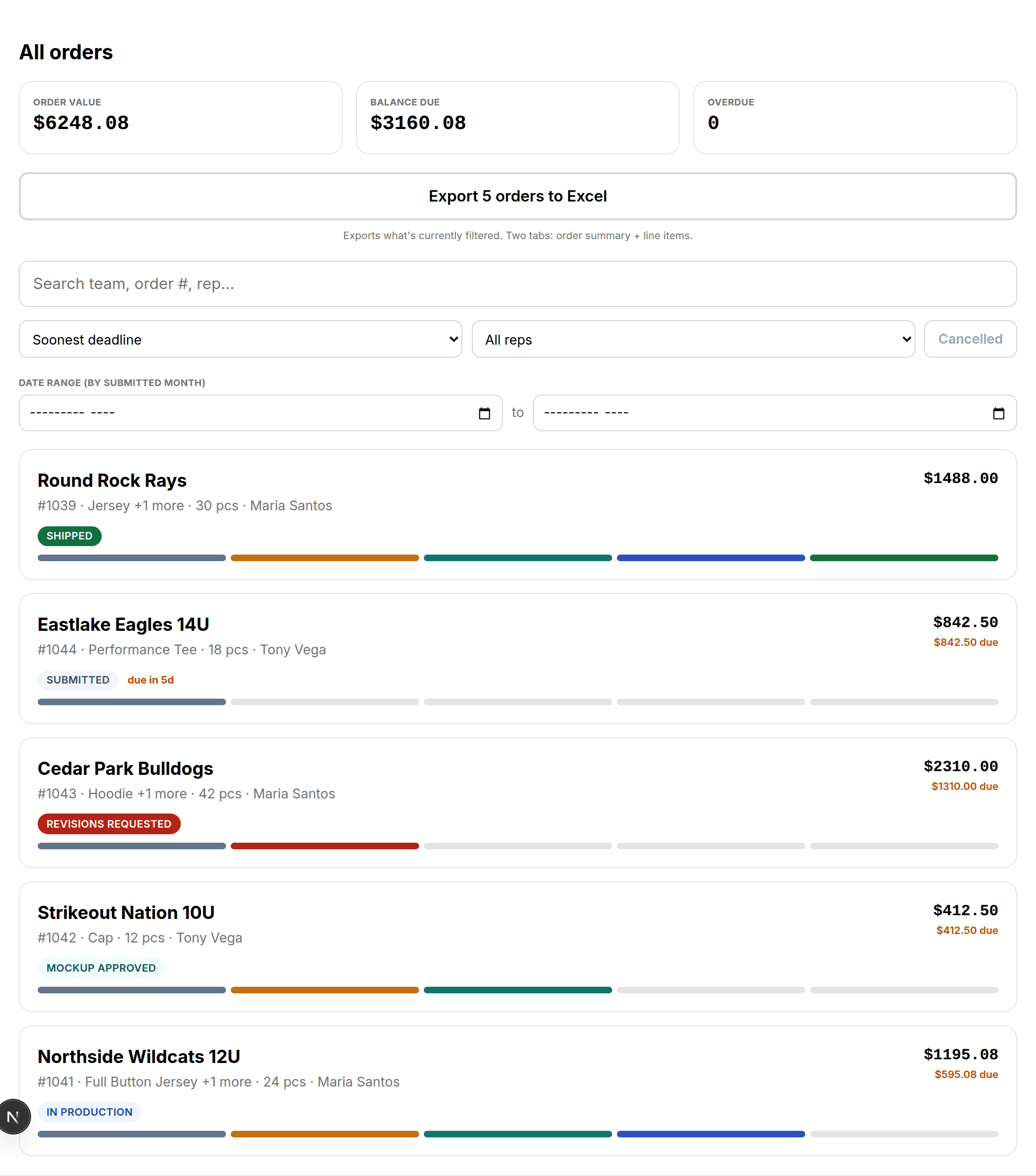
The coach fills out their own order, approves their own design, and pays against it.
Your customer's own order form
Each rep gets one permanent link. The customer picks from your real price list, with your payment terms and turnaround on the page, and it lands in your queue under that rep's name.
Priced at that rep's own prices — the spread between what they charge and what they owe you is how they're paid.
They approve the design themselves
The coach opens the mockup on their phone and approves it, or says exactly what to change. No screenshot, no text thread, no “did you get my last message”.
A tracking page with no login
Every order gets a short code. The customer sees plain-language progress, what they owe, and a Venmo or Cash App button pre-filled with the amount and the reference.
They're told “in design” and “in production”, not “mockup_pending”.
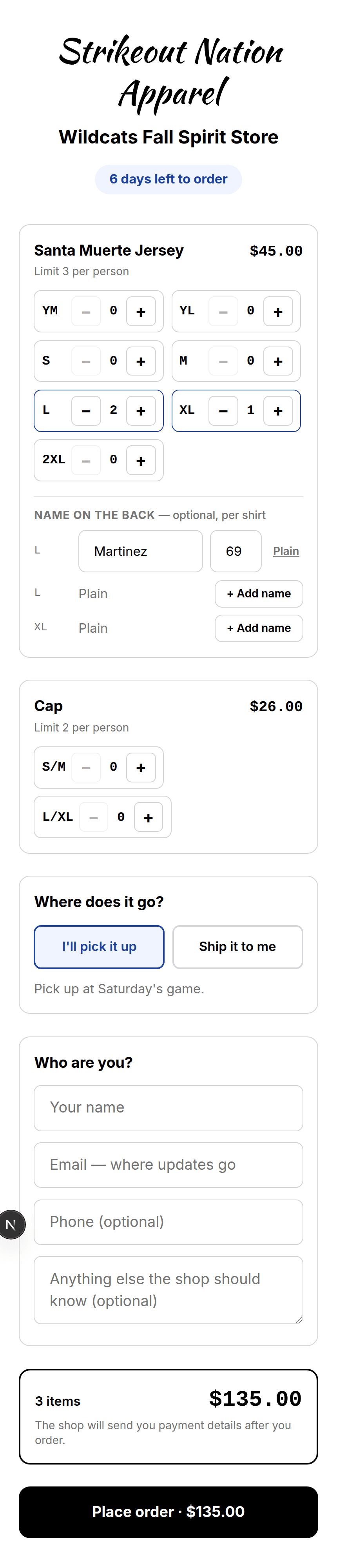
Team stores for buy-ins
One design, forty buyers, one link in the group chat. Everyone picks their own size, decides shirt by shirt whether they want a name on the back, and chooses ship-to-me or collect.
It comes back as one job for the press and one roster, while every garment still knows whose it is.
Sell what's already on the shelf
One link that sells your in-stock blanks, spirit-wear and leftovers at your catalogue prices, with a photo on each. Every sale counts the shelf down on its own and lands on your board like any other order.
Two people tapping buy on the last XL at the same time cannot both get it — the shelf is taken in the database, and the second is told before anything is promised.
Your logo, not ours
Upload it once and it heads every receipt, tracking page, order form and team store. The customer sees your shop, not the software.
Making it
The document your shop floor actually works from, and the email that delivers it.
A production sheet with no prices on it
Size run, every item with its decoration, and every name and number as one numbered list with tick boxes. Artwork printed, not linked.
No margins anywhere on it, so it can be handed to a contract printer as-is.
The job arrives by email
The moment an order is cleared for production, everyone who needs it gets the whole thing — size run, roster, ship-to, rep name, and the approved mockup attached as a real file.
Only the approved proof is ever attached. If nothing on the order is approved artwork, the email says so in capitals and says not to press from it.
Roster counted against garments
The sheet warns at the top when names and pieces don't match. Twelve jerseys run and three come off blank is a specific, expensive mistake.
Build sheets your vendor can read
Every order exports as a size tally and a manufacturer-ready build order — the spreadsheet most shops rebuild by hand.
The money
Profit per order, not just revenue — and a straight answer on what each rep is owed.
Cost per line, from your vendor
Record what each item actually cost you, plus shipping and supplies, and Reports shows profit per order rather than revenue per order.
Most shops genuinely don't know which orders made money.
Reps keep the spread
You set what a rep owes you per item. They set what the customer pays. The difference is theirs, on every order — typed in, through their link, or through a buy-in they set up.
The database refuses a line below their cost, so nobody can accidentally work at a loss.
Payments and balances
Record what came in, against which order, by which method. The balance follows everywhere — the board, the receipt, the tracking page, the reminder emails.
Sales tax that can't be switched off by accident
A flat 8.25% on the items after any discount, never on shipping. One switch per shop, and a per-order exemption for schools and booster clubs.
Tax is never counted as revenue — it's collected for the state, so it's left out of profit and partner splits.
Partner splits and vendor payables
What each partner is owed and what you've paid each vendor, in one place, on a page only the owner can open.
Running without you
The things that happen whether or not anybody opens the app.
One email each morning
Orders waiting on a mockup, customers who asked for changes, mockups gone quiet, anything overdue or due within a week, anything shipped that still owes money.
Only when there's something in it. No email means nothing needs you — a daily “all clear” is how a summary becomes something people filter.
Your customers get chased
A coach sitting on a mockup for four days gets one nudge. An order that shipped owing money gets asked about — at most three times, ten days apart, signed with your shop's name.
Each shop can switch it off entirely.
Backed up off-site every night
Your whole shop exported and emailed out each night, with a written list of which tables must be in it.
A backup quietly missing a third of the data is worse than none, because it's trusted.
Nobody is emailed about their own work
Advance six orders and you get zero emails, not six. That single rule is most of the difference between a notification people read and one they filter away.
Your team
Reps on phones, managers on the board, and one owner who sees the money.
Reps sign in with a PIN
Name and a four-digit PIN. No email address required, no password reset call on a Saturday.
Three roles that layer
A rep sees their own orders and their own earnings. A manager sees everything and moves orders through. The owner adds profit, partner splits and billing.
Enforced in the database, not just hidden on screen — a rep can't reach another rep's numbers even deliberately.
Move a sale between reps
Whoever's link a customer opens becomes the rep on that order. When that's wrong, change it in one tap and the earnings follow.
An activity feed per order
Mockup sent, payment recorded, status changed, tracking added — who did it and when, on the order and shop-wide.