For team & spirit-wear shops
Team apparel orders,
off the group chat.
A coach sends 24 names and numbers in a text. Somewhere in that thread is the deadline, the sizes, and half a Venmo screenshot. Apparel Logic is where that order actually lives.
Try it — no sign-up
Paste the coach's list. However they wrote it.
This is the actual parser from inside the app, running in your browser. Edit the text and watch the order change.
Type anything. Commas, hashes, line numbers, “Med”, “Youth Large” — it reads them all. A line with just a size on it is one plain piece. Runs in your browser; nothing is sent anywhere.
| Name | No. | Size |
|---|---|---|
| Alvarez | 7 | YM |
| Brooks | 12 | YL |
| Chen | 3 | M |
| Diaz | 21 | L |
| Ellis | 9 | L |
| Fowler | 44 | XL |
| Grant | 5 | M |
| no name — plain piece | — | L |
| Huang | 18 | 2XL |
1 with a size and no name — a plain piece, nothing printed on the back.
What it looks like
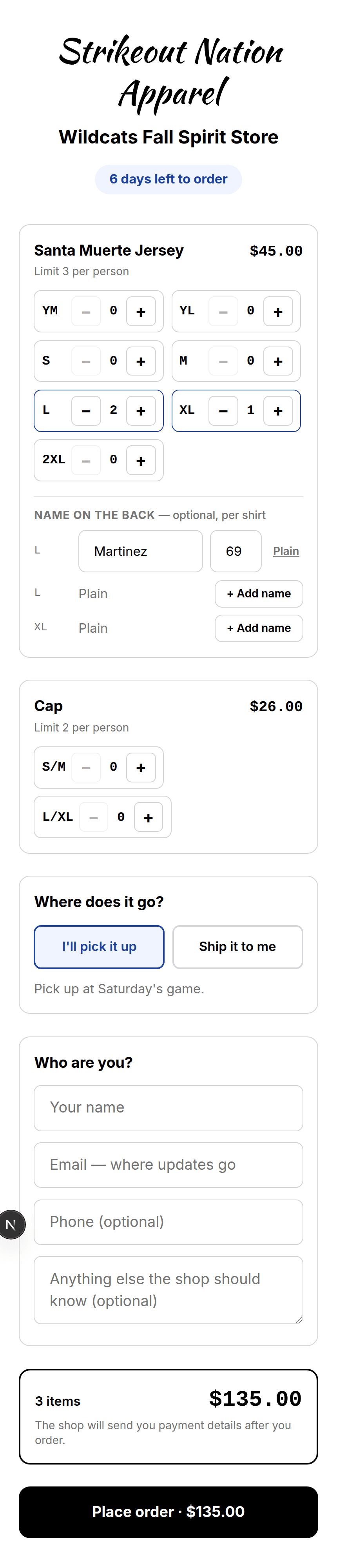
Built on a phone, for people standing in a gym.

Every order, one screen
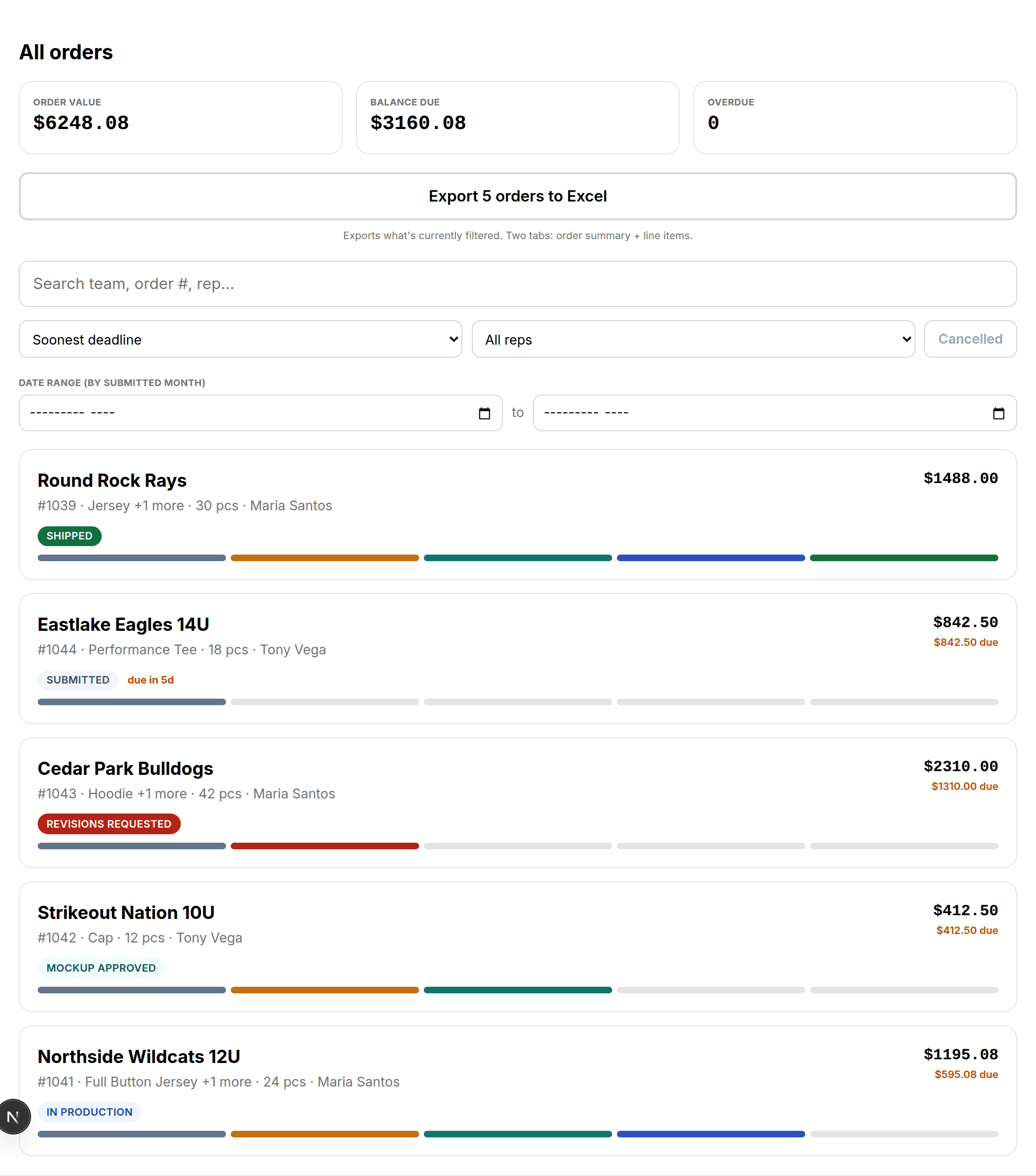
Know what's late before the coach does.
Order value, balance due and overdue count across whatever you've filtered to. Search by team, order number or rep. Export exactly what's on screen to Excel — order summary and line items, two tabs.
The spine
Six stages, and two vocabularies.
Your shop sees its own words. The customer is told something plainer on their tracking page, because “Mockup Sent” is jargon to anyone waiting on a jersey.
- 01Submittedthey see received
- 02Mockup Sentthey see in design
- 03Mockup Approvedthey see design approved
- 04Ready for Productionthey see ready for production
- 05In Productionthey see in production
- 06Shippedthey see shipped
The rest of it
Built for rosters, not print jobs.
Most shop software is built for a production floor. Team apparel is a different job, and these are the parts nobody else gets right.
Taking the order
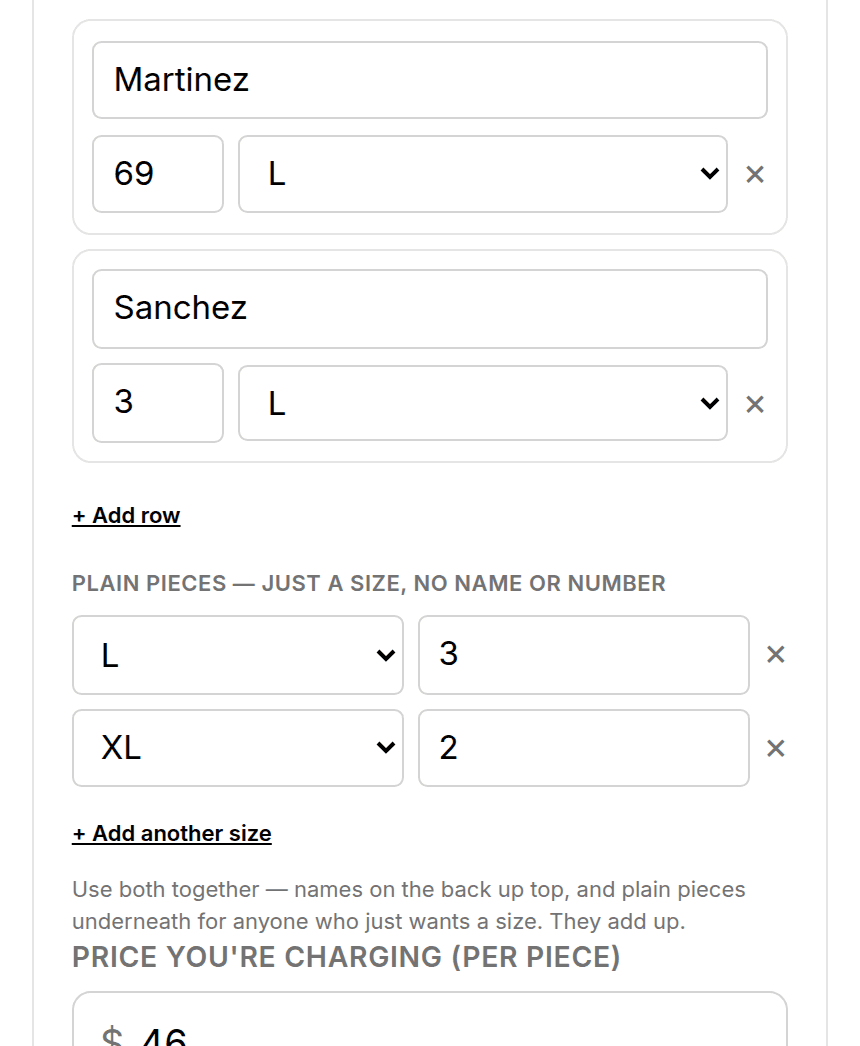
The part every other tool gets wrong. Team apparel is a roster, not a line item.
- Paste the whole roster — A coach's list goes in as one paste — names, numbers and sizes, in whatever format it arrived in. Save it and it prefills next season.
- Named and plain on one item — Twelve players with names on the back plus five blanks for the coaches is one line, not two. The roster and a plain size grid sit together and add up.
- Nothing is dropped quietly — Any line the paste box can't read is listed back to you before the roster is added. A player with no size comes in as a real row, flagged.
Working with the customer
The coach fills out their own order, approves their own design, and pays against it.
- Your customer's own order form — Each rep gets one permanent link. The customer picks from your real price list, with your payment terms and turnaround on the page, and it lands in your queue under that rep's name.
- They approve the design themselves — The coach opens the mockup on their phone and approves it, or says exactly what to change. No screenshot, no text thread, no “did you get my last message”.
- A tracking page with no login — Every order gets a short code. The customer sees plain-language progress, what they owe, and a Venmo or Cash App button pre-filled with the amount and the reference.
Making it
The document your shop floor actually works from, and the email that delivers it.
- A production sheet with no prices on it — Size run, every item with its decoration, and every name and number as one numbered list with tick boxes. Artwork printed, not linked.
- The job arrives by email — The moment an order is cleared for production, everyone who needs it gets the whole thing — size run, roster, ship-to, rep name, and the approved mockup attached as a real file.
- Roster counted against garments — The sheet warns at the top when names and pieces don't match. Twelve jerseys run and three come off blank is a specific, expensive mistake.
The money
Profit per order, not just revenue — and a straight answer on what each rep is owed.
- Cost per line, from your vendor — Record what each item actually cost you, plus shipping and supplies, and Reports shows profit per order rather than revenue per order.
- Reps keep the spread — You set what a rep owes you per item. They set what the customer pays. The difference is theirs, on every order — typed in, through their link, or through a buy-in they set up.
- Payments and balances — Record what came in, against which order, by which method. The balance follows everywhere — the board, the receipt, the tracking page, the reminder emails.
Running without you
The things that happen whether or not anybody opens the app.
- One email each morning — Orders waiting on a mockup, customers who asked for changes, mockups gone quiet, anything overdue or due within a week, anything shipped that still owes money.
- Your customers get chased — A coach sitting on a mockup for four days gets one nudge. An order that shipped owing money gets asked about — at most three times, ten days apart, signed with your shop's name.
- Backed up off-site every night — Your whole shop exported and emailed out each night, with a written list of which tables must be in it.
Your team
Reps on phones, managers on the board, and one owner who sees the money.
- Reps sign in with a PIN — Name and a four-digit PIN. No email address required, no password reset call on a Saturday.
- Three roles that layer — A rep sees their own orders and their own earnings. A manager sees everything and moves orders through. The owner adds profit, partner splits and billing.
- Move a sale between reps — Whoever's link a customer opens becomes the rep on that order. When that's wrong, change it in one tap and the earnings follow.
Pricing
Every plan includes orders, pricing, customers, tracking links, production sheets and receipts. Yearly is two months free.
Starter
$99/mo
or $990/year
One shop, a couple of people, taking orders properly instead of on paper.
Up to 3 staff
Pro
Most shops$199/mo
or $1,990/year
A real team, tracking what each order actually costs and letting customers order themselves.
Up to 10 staff
Unlimited
$299/mo
or $2,990/year
Everything, no seat limit, with partner splits and vendor payments.
Unlimited staff